

Ideas come easily. Talking about them is simple, but turning them into reality is a completely different challenge. It takes commitment, time and, of course, money. Above all, however, success depends on the people involved.
Where Do You Start?
Throughout my professional life as an engineer and entrepreneur, I have learned how to turn ideas into reality. For me, bringing a vision to life begins with a strategy – a path that appears promising and achievable.
One tool I have always relied on is a phased plan with clearly defined milestones and a rough timeline. It helps visualise what we want to achieve, the order in which the individual steps should take place and the conditions that need to be met along the way.
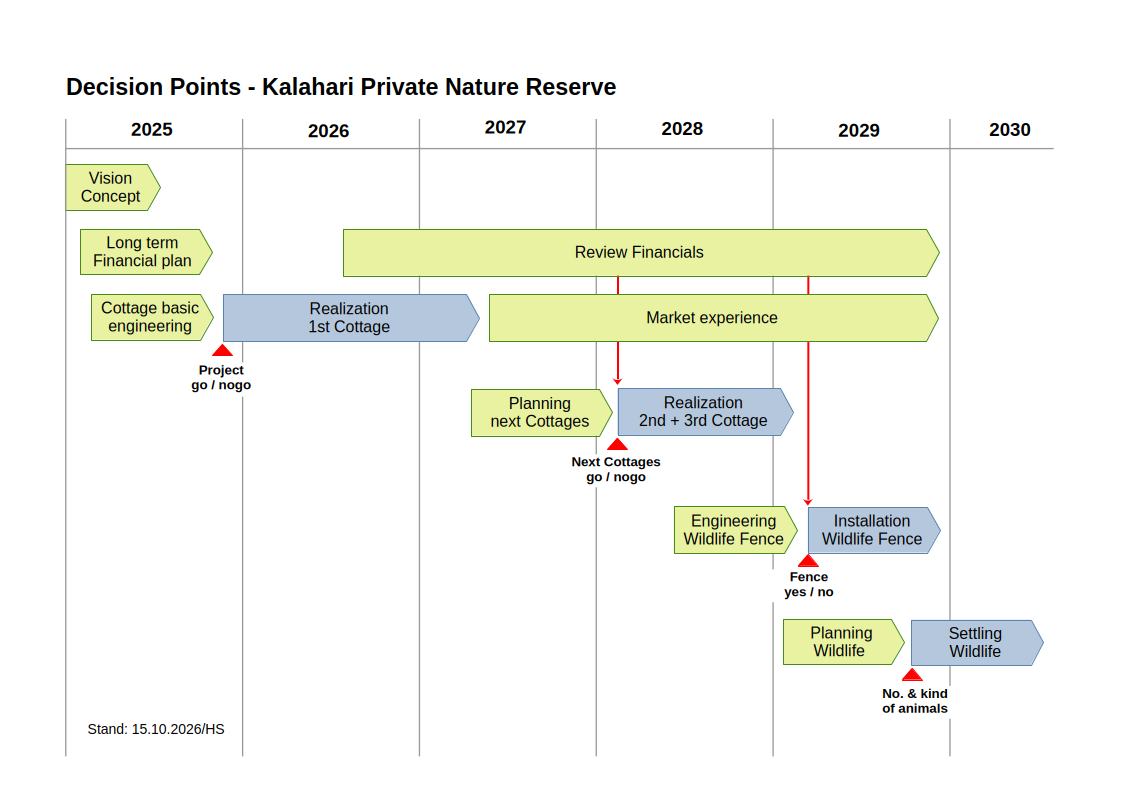
Our plan is to start by building a single cottage for two people on a Kalahari dune. Construction will begin once the business plan confirms the project's economic viability.
If the new tourism offering proves successful, two additional cottages will follow.
Once the concept has demonstrated its long-term potential, the next major step will be to convert part of the farmland into a wildlife reserve. The three cottages will be located within this area, which will be separated from the remaining agricultural land by a wildlife fence.
Initially, the reserve will be home to wildlife species typical of the Kalahari, particularly gemsbok (oryx), kudu and springbok.
What Does the Business Plan Tell Us?
When translating the phased plan into financial figures, one objective took priority over everything else: The financial security of the family who depend on the farm for their livelihood must be maintained throughout the entire transition.
This led to a business model in which tourism revenue gradually increases while livestock numbers are reduced accordingly.
Completely abandoning livestock farming would, in my view, be irresponsible. It would create too much dependence on tourism. We have already experienced how quickly international travel can come to a standstill.
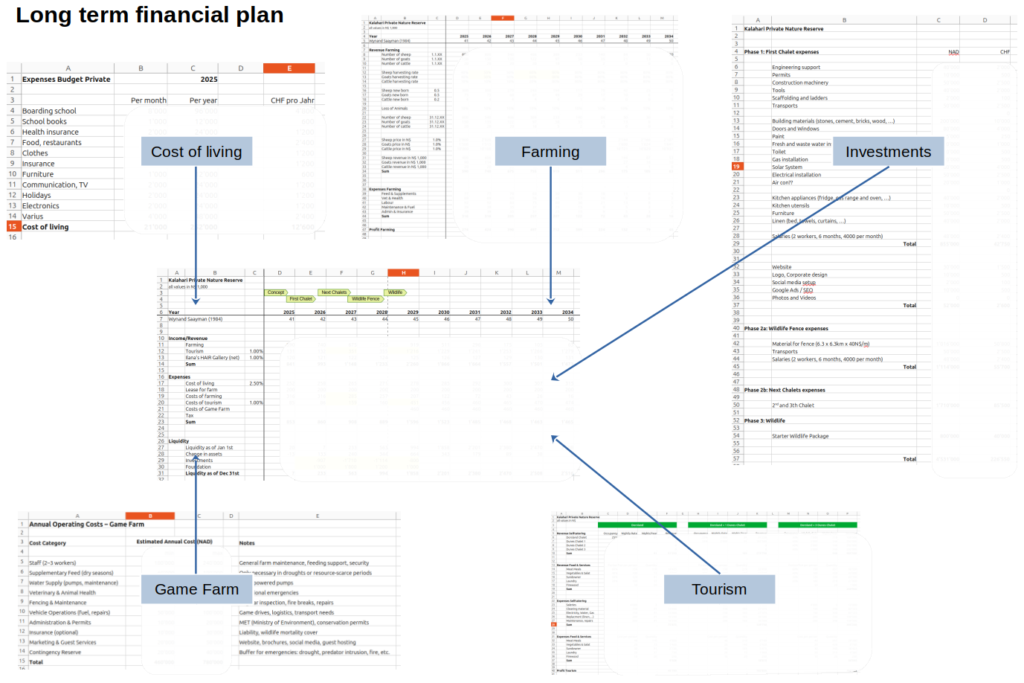
The business plan therefore takes both existing farming operations and the planned tourism activities into account:
- The family's living expenses
- Revenue and operating costs of livestock farming
- Investments in tourism infrastructure
- Expected income and operating costs of the cottages
- Investments and annual operating costs of the wildlife reserve
All these elements were brought together in a central financial model. This allows us to estimate how the farm's financial situation will develop throughout the different project phases.
The results were encouraging. Even with my rather conservative assumptions, the business plan indicated a positive financial outlook.
An important prerequisite for taking the next steps had therefore been met.
How Did the Family Respond?
In May 2025, I travelled to Namibia with the completed planning documents to discuss everything with the family.
Together, we reviewed the phased plan and financial assumptions, discussed different options and adjusted the plans where necessary.
In the meantime, Wynand had also updated his architectural drawings. The idea of building guest accommodation on the farm had been on his mind for a long time, and he already had some designs tucked away in a drawer.
Using these plans as a starting point, we worked together to prepare a more detailed budget for the first cottage.
We also discussed the legal and administrative requirements for constructing the cottage and its access road. Based on the information available locally, we did not initially expect any major obstacles.
Can You Build on a Sand Dune?
My wish to build the first cottage on a Kalahari dune initially sounded rather unusual. After all, building a house on sand is hardly an everyday undertaking.
On the other hand, I knew that the dunes in this region had remained largely in the same locations for a very long time. So why shouldn't it be possible to construct a small building on one of them?
After all, some of the tallest buildings in the world stand on sandy ground in Dubai – although they rely on sophisticated foundation systems.
The decisive factor is not the sand itself, but choosing the right construction method and suitable foundations.
Fortunately, an opportunity arose to visit a comparable building project nearby. Wynand's father-in-law knew a contractor who had built a villa on a dune about ten years earlier.
He arranged a visit for us. We were able to examine the construction, exchange experiences and learn a great deal about the practical challenges of building on sand.
This confirmed our belief that building a cottage on a Kalahari dune is technically feasible.
The Project Takes Shape
After ten intensive days of discussions, calculations, site visits and joint decisions, we had reached a point where everyone was satisfied with the plans and we were ready to take the next step.
What had started as an idea had become a concrete project. The phased plan was in place, the business plan showed a promising financial outlook, and architectural drawings and a budget had been prepared for the first cottage.
The planning phase was complete. It was time to turn our plans into reality.